One year ago, after his breathtakingly beautiful Iranian drama, "A Separation," won the Academy Award for Best Foreign Film, writer/director Asghar Farhadi delivered
the best acceptance speech of the night.
"[A]t the time when talk of war, intimidation, and aggression is exchanged between politicians," he said, Iran was finally being honored for "her glorious culture, a rich and ancient culture that has been hidden under the heavy dust of politics." Farhadi dedicated the Oscar "to the people of my country, a people who respect all cultures and civilizations and despise hostility and resentment."
Such grace and eloquence will surely not be on display this Sunday, when Ben Affleck, flanked by his co-producers George Clooney and Grant Heslov, takes home the evening's top prize, the Best Picture Oscar, for his critically-acclaimed and
heavily decorated paean to the CIA and American innocence, "Argo."
Over the past 12 months, rarely a
week - let alone
month - went by without new
predictions of an ever-imminent Iranian nuclear weapon and ever-looming threats of an American or Israeli military attack. Come October 2012, into the fray marched "Argo," a
decontextualized, ahistorical "true story" of
Orientalist proportion, subjecting audiences to two hours of American victimization and bearded barbarians, culminating in popped champagne corks and rippling stars-and-stripes celebrating
our heroism and triumph and
their frustration and defeat.
Salon's Andrew O'Hehir aptly described the film as "a propaganda fable," explaining
as others have that
essentially none of its edge-of-your-seat thrills or most memorable moments ever happened. O'Hehir
sums up:
The Americans never resisted the idea of playing a film crew, which is the source of much agitation in the movie. (In fact, the “house guests” chose that cover story themselves, from a group of three options the CIA had prepared.) They were not almost lynched by a mob of crazy Iranians in Tehran’s Grand Bazaar, because they never went there. There was no last-minute cancellation, and then un-cancellation, of the group’s tickets by the Carter administration. (The wife of Canadian ambassador Ken Taylor had personally gone to the airport and purchased tickets ahead of time, for three different outbound flights.) The group underwent no interrogation at the airport about their imaginary movie, nor were they detained at the gate while a member of Iran’s Revolutionary Guard telephoned their phony office back in Burbank. There was no last-second chase on the runway of Mehrabad Airport, with wild-eyed, bearded militants with Kalashnikovs trying to shoot out the tires of a Swissair jet.
One of the
actual diplomats, Mark Lijek,
noted that the CIA's fake movie "cover story was never tested and in some ways proved irrelevant to the escape." The departure of the six Americans from Tehran was actually mundane and uneventful. "If asked, we were going to say we were leaving Iran to return when it was safer," Lijek recalled, "But no one ever asked!...The truth is the immigration officers barely looked at us and we were processed out in the regular way. We got on the flight to Zurich and then we were taken to the US ambassador's residence in Berne. It was that straightforward."
Furthermore, Jimmy Carter has even
acknowledged that "90% of the contributions to the ideas and the consummation of the plan was Canadian [while] the movie gives almost full credit to the American CIA...Ben Affleck's character in the film was only in Tehran a day and a half and the real hero in my opinion was
Ken Taylor, who was the Canadian ambassador who orchestrated the entire process."
Taylor himself recently
remarked that "Argo" provides a myopic representation of both Iranians and their revolution, ignoring their "more hospitable side and an intent that they were looking for some degree of justice and hope and that it all wasn't just a violent demonstration for nothing."
"The amusing side," Taylor said, "is the script writer in Hollywood had no idea what he's talking about."
O'Hehir perfectly articulates the film's true crime, its deliberate exploitation of "its basis in history and its mode of detailed realism to create something that is entirely mythological." Not only is it "a trite cavalcade of action-movie clichés and expository dialogue," but "[i]t’s also a propaganda movie in the truest sense, one that claims to be innocent of all ideology."
Such an assessment is confirmed by Ben Affleck's own comments about the film. In describing "Argo" to Bill O'Reilly, Affleck
boasted, "You know, it was such a great story. For one thing, it's a thriller. It's actually comedy with the Hollywood satire. It's a complicated CIA movie, it's a political movie. And it's all true." He
told Rolling Stone that, when conceiving his directorial approach, he knew he "
absolutely had to preserve the central integrity and truth of the story."
"It's OK to embellish, it's OK to compress, as long as you don't fundamentally change the nature of the story and of what happened," Affleck has
remarked, even going so far as to tell
reporters at Argo's BFI London Film Festival premier, "This movie is about this story that took place, and it's true, and I go to pains to contextualize it and to try to be even-handed in a way that just means we're taking a cold, hard look at the facts."
In an
interview with
The Huffington Post, Affleck went so far as to say, "I tried to make a movie that is absolutely just factual. And that's another reason why I tried to be as true to the story as possible -- because I didn't want it to be used by either side. I didn't want it to be politicized internationally or domestically in a partisan way. I just wanted to tell a story that was about the facts as I understood them."
For Affleck, these facts apparently don't include understanding
why the American Embassy in Tehran was overrun and occupied on November 4, 1979. "There was no rhyme or reason to this action," Affleck
has insisted, claiming that the takeover "wasn't about us," that is, the American government (despite the fact that his own film is introduced by a fleeting - though frequently inaccurate
1 - review of American complicity in the Shah's dictatorship).
Wrong, Ben. One reason was the fear of another
CIA-engineered coup d'etat like the one perpetrated in 1953 from the very same Embassy. Another reason was the admission of the deposed Shah into the United States for medical treatment and asylum rather than extradition to Iran to face charge and trial for his quarter century of
crimes against the Iranian people, bankrolled and supported by the U.S. government. One doesn't have to agree with the reasons, of course, but they certainly existed.
Just as George H.W. Bush once bellowed after a U.S. Navy warship
blew an Iranian passenger airliner out of the sky over the Persian Gulf, killing 290 Iranian civilians, "I'll never apologize for the United States of America. Ever. I don't care what the facts are." Affleck appears inclined to agree.
If nothing else, "Argo" is an exercise in
American exceptionalism - perhaps the most dangerous
fiction that permeates our entire society and sense of identity. It reinvents history in order to mine a tale of triumph from an unmitigated defeat. The hostage crisis, which lasted 444 days and destroyed an American presidency, was a failure and an embarrassment for Americans. The United States government and media has spent the last three decades tirelessly exacting revenge on Iran for what happened.
"Argo" recasts revolutionary Iranians as the hapless victims of American cunning and deception. White Americans are hunted, harried and, ultimately courageous and free. Iranians are maniacal, menacing and, in the end, infantile and foolish. The fanatical fundamentalists fail while America wins. USA -1, Iran - 0. Yet, "Argo" obscures the unfortunate truth that, as those six diplomats were boarding a plane bound for Switzerland on January 28, 1980, their 52 compatriots would have to wait an entire year before making it home, not as the result of a daring rescue attempt, but after a diplomatic agreement was reached.
Reflecting on the most troubled episodes in American history is a time-honored cinematic tradition. There's a reason why the best Vietnam movies are full of pain, anger, anguish and war crimes. By contrast, "Argo" is American catharsis porn; pure Hollywood hubris. It is pro-American propaganda devoid of introspection, pathos or humility and meant to assuage our hurt feelings. In "Argo," no lessons are learned by revisiting the consequences of America's support for the Pahlavi monarchy or its creation and training of SAVAK, the Shah's
vicious secret police.
On June 11, 1979, months before the hostage crisis began, the
New York Times published an
article by writer and historian A.J. Langguth which recounted revelations relayed by a former American intelligence official regarding the CIA's close relationship with SAVAK. The agency had "sent an operative to teach interrogation methods to SAVAK" including "instructions in torture, and the techniques were copied from the Nazis." Langguth wrestled with the news, trying to figure out why this had not been widely reported in the media. He came to the following conclusion:
We – and I mean we as Americans – don’t believe it. We can read the accusations, even examine the evidence and find it irrefutable. But, in our hearts, we cannot believe that Americans have gone abroad to spread the use of torture.
We can believe that public officials with reputations for brilliance can be arrogant, blind or stupid. Anything but evil. And when the cumulative proof becomes overwhelming that our representatives in the C.I.A. or the Agency for International Development police program did in fact teach torture, we excuse ourselves by vilifying the individual men.
Similarly, at a time when the CIA is waging an
illegal,
immoral,
unregulated and
always expanding drone execution program, the previous administration's
CIA kidnappers and torturers are
protected from
prosecution by the
current administration, and leaked State Department cables reveal
orders for U.S. diplomats to spy on United Nations officials, it is surreal that such homage is being paid to that very same organization by the so-called liberals of the Tinsel Town elite.
Upon winning his Best Director Golden Globe last month, Ben Affleck obsequiously
praised the "clandestine service as well as the foreign service that is making sacrifices on behalf of the American people everyday [and] our troops serving over seas, I want to thank them very much," a statement
echoed almost identically by co-producer Grant Heslov when "Argo" later won Best Drama.
This comes as no surprise, considering Affleck had previously
described "Argo" as "a tribute" to the "extraordinary, honorable people at the CIA" during an interview on
Fox News.
The
relationship between
Hollywood and the
military and intelligence arms of the
U.S. government have
long been cozy. "When the CIA or the Pentagon says, 'We'll help you, if you play ball with us,' that's favoring one form of speech over another. It becomes propaganda," David Robb, author of "Operation Hollywood: How the Pentagon Shapes and Censors the Movies"
told The Los Angeles Times. "The danger for filmmakers is that their product — entertainment and information — ends up being government spin."
Awarding "Argo" the Best Picture Oscar is like Barack Obama winning a Nobel Peace Prize: an undeserved accolade fawningly bestowed upon a dubious recipient based on a
transparent fiction; an award for what never was and never would be and a decision so willfully naïve and grotesque it discredits whatever relevance and prestige the proceedings might still have had.*
So this Sunday night, when "Argo" has won that coveted golden statuette, it will be clear that we have yet again been blinded by the heavy dust of politics and our American mantra of hostility and resentment will continue to inform our decisions, dragging us closer and closer to the abyss.
***** ***** *****
* Yes, in this analogy, the equivalent of Henry Kissinger is
obviously 2004's dismal "Crash."
*****
FOOTNOTES & UPDATES:
1 The introduction of "Argo" is a dazzlingly sloppy few minutes of caricatured history of Iran, full of Orientalist images of violent ancient Persians (scimitars and all), which gets many basic facts wrong. In truth, it is shocking this intro made it to release as written and recorded.
Here are some of the problems:
1. The voiceover narration says, "In 1950, the people of Iran elected Mohammad Mossadegh, the secular democrat, Prime Minister. He nationalized British and U.S. petroleum holdings, returning Iran’s oil to its people."
Mossadegh was elected to the
Majlis (Iranian Parliament) in 1944. He did not become Prime Minister until April 1951 and was not "elected by the people of Iran." Rather, he was appointed to the position by the representatives of the Majlis.
Also, the United States did not have petroleum interests in Iran at the time.
2. After briefly describing the 1953 coup, the narrator says Britain and the United States "installed Reza Pahlavi as Shah."
Wow. First, the Shah's name was not Reza Pahlavi. That is his
father's (and son's) name. Furthermore, Mohammad Reza Pahlavi was not
installed as Shah since he had
already been Shah of Iran since September 1941, after Britain and the Soviet Union invaded and occupied Iran and forced the abdication of his father, Reza Shah Pahlavi.
During the coup in 1953, the Shah fled to Baghdad, then Rome. After Mossadegh had been forced out, the Shah returned to the Peacock Throne.
This is not difficult information to come by, and yet the screenwriter and director of "Argo" didn't bother looking it up. And guess what? Ben Affleck actually majored in Middle East Studies in college. Unsurprisingly, he didn't graduate.
The rest of the brief intro, while mentioning the torture of SAVAK, omits any mention of its
ties to the CIA, glosses over the causes of the revolution, but lingers on the violence that followed. As it ends, the words "Based on a True Story" appear on the screen. The first live action moment we see in "Argo" is of an American flag being burned.
So much for Affleck's
insistence that "Argo" is "not a political movie."
Still, as Kevin B. Lee
wrote in
Slate last month, "This opening may very well be the reason why critics have given the film credit for being insightful and progressive—because nothing that follows comes close, and the rest of the movie actually undoes what this opening achieves."
He continues,
Instead of keeping its eye on the big picture of revolutionary Iran, the film settles into a retrograde “white Americans in peril” storyline. It recasts those oppressed Iranians as a raging, zombie-like horde, the same dark-faced demons from countless other movies— still a surefire dramatic device for instilling fear in an American audience. After the opening makes a big fuss about how Iranians were victimized for decades, the film marginalizes them from their own story, shunting them into the role of villains. Yet this irony is overshadowed by a larger one: The heroes of the film, the CIA, helped create this mess in the first place. And their triumph is executed through one more ruse at the expense of the ever-dupable Iranians to cap off three decades of deception and manipulation.
And brilliantly concludes,
Looking at the runaway success of this film, it seems as if critics and audiences alike lack the historical knowledge to recognize a self-serving perversion of an unflattering past, or the cultural acumen to see the utterly ersatz nature of the enterprise: A cast of stock characters and situations, and a series of increasingly contrived narrow escapes from third world mobs who, predictably, are never quite smart enough to catch up with the Americans. We can delight all we like in this cinematic recycling act, but the fact remains that we are no longer living in a world where we can get away with films like this—not if we want to be in a position to deal with a world that is rising to meet us. The movies we endorse need to rise to the occasion of reflecting a new global reality, using a newer set of storytelling tools than this reheated excuse for a historical geopolitical thriller.
Another astute observation comes from Sarah Gillespie,
writing in
The Palestine Chronicle this past November:
In short, ‘Argo’ ultimately reinforces the binary opposition of a civilized West and a savage Iran. We hear a lot of Farsi in the movie, but only when Farsi is spoken by a Western character is the dialogue given subtitles. Farsi spoken by Iranian characters in the film is merely incomprehensible noise. Here the film accurately mirrors our contemporary reality, in which we inflict our discourse on Iranians, but are incapable of listening to theirs.
Nevertheless, in his own comments on the script-writing process during a
Hollywood Reporter's Writers Roundtable discussion last November, "Argo" screenwriter Chris Terrio explained that the intention behind the film's brief prologue was to provide context. "This isn't just a generic image of what we think of as the Arab Street," he said, "Angry people who seem to be burning flags for no reason. You needed to understand the source of the rage."
When Terrio was asked about the film's "liberties with factual truth" and how far he and Affleck thought they "could bend the truth to make a story more effective," Terrio hemmed and hawed about presenting "a very complicated situation" and determining "how much information can we present that the audience [will understand]."
"What's the breaking point for that amount of narrative information?," he said rhetorically, before answering, "Although deviating from factual truth...I don't feel like we compromised in any essential thematic way."
While Terrio did not visit Iran during his writing process, he said he "did as much research as I could." this apparently did not involve learning the proper name of the deposed Shah. So where did his information come from? "I spent a bunch of time with Tony Mendez and also bunch of other CIA officers," he said, before revealing what great guys they all are.
Later in the discussion, Terrio even furrowed his brow and pondered a philosophical conundrum. "I'm not sure of the ethical implications of taking real people's lives and trying to make it a nail-biter," he said.
Clearly.
*****
UPDATE:
February 25, 2013 - On the heels of Oscar Night's unsurprising coda (made all the more bizarre by the inclusion of Michelle Obama, surrounded by awkward-looking military personnel, presenting the Best Picture to "Argo" from the White House, providing a deeply disturbing governmental imprimatur to the entire proceedings),
The Los Angeles Times published a report Monday morning about how "Argo" is being perceived in Iran by Iranians themselves.
The conclusion is clear from the headline:
'Argo's' Oscar gets a thumbs-down in Iran. Journalists Ramin Mostaghim and Patrick J. McDonnell quote several Iranians who have seen the movie, bootlegs of which are widely available, all of whom clearly have a better grasp on, not only the politics, but also the art (or lack thereof) of cinema itself. "The perception that the film portrayed Iranians uniformly as bearded, violent fanatics rankled many who recall that Iran's 1979 revolution had both secular and religious roots -- and ousted a dictatorial monarch, the shah of Iran, reviled as a corrupt and brutal puppet of Washington," Mostaghim and McDonnel explain. Here's what we hear from Iranians themselves:
"I am secular, atheist and not pro-regime but I think the film 'Argo' has distorted history and insulted Iranians," said Hossain, a cafe owner worried about business because of customers' lack of cash in a sanctions-battered economy. "For me, it wasn't even a good thriller."
"I did not enjoy seeing my fellow countrymen and women insulted," said Farzaneh Haji, an educated homemaker and fan of romantic movies who was 18 at the time of the revolution. "The men then were not all bearded and fanatical. To be anti-American was a fashionable idea among young people across the board. Even non-bearded and U.S.-educated men and women were against American imperialism."
"As an action film or thriller, the film was good, but it was not believable, especially the way the six Americans escaped from the airport," said Farshid Farivar, 49, a Hollywood devotee, as he stretched his legs in an office where he does promotional work. "At any rate, it was an average film and did not deserve an Oscar."
The piece ends with the reporters speaking with
Abbas Abdi, one of the revolutionary students who planned the seizure of the American Embassy in 1979 and who spent some time in prison a decade ago for criticisms of the Iranian government:
In a brief telephone interview on Monday, Abdi said the Oscars had plummeted to the feeble level of Iran's own Fajr Film Festival, not exactly one of the luminaries on the international movie awards circuit.
"The Oscars are now vulgar and have standards as low as our own film festival," he said. "The Oscars deserve 'Argo' and 'Argo' deserves the Oscars."
An
Associated Press report also quotes some Iranians about their views on the film. Mohammad Amin Sharifi, a self-described cinephile in Tehran, said, "In my opinion, it's a nice movie from technical aspects and it was on the scale of Hollywood movies, but I don't think it was worth a nomination for Oscar and other awards."
USA Today also has an Oscar follow-up entitled, "
Tourists see a different Iran reality than 'Argo' image," which details the warmth, generosity and hospitality of Iranians experienced by travelers when visiting Iran.
Robert Parry over at
Consortiumnews has posted an
excellent article on "Argo" in which he writes that the film has "largely draw[n] its narrative in black and white, with strong propaganda overtones, feeding into the current hostility between the United States and Iran over its nuclear program."
Further, Parry notes, "Despite a brief documentary-style opening referencing the 1953 coup and the dictatorial rule of the Shah of Iran until 1979,
Argo quickly descended into a formulaic tale of sympathetic CIA officers trying to outwit nasty Iranian revolutionaries, complete with a totally made-up thriller escape at the end."
He concludes, "
Argo confirms to many average Americans the unreasonableness of Iranians, who are portrayed as both evil and inept. If negotiations over Iran’s nuclear program collapse, this propaganda image of the Iranians could help tilt the balance of U.S. public opinion toward war."
*****
UPDATE II:
February 26, 2013 - Canada's leading newspaper the
Globe and Mail has
published an interview with former Canadian Ambassador to Iran, Ken Taylor, the man who was primarily responsible for the hiding and rescue of the six American diplomats whose story is told in "Argo."
Taylor, while accepting "Hollywood’s penchant for poetic licence," still takes the time to set the record straight.
On the fake Hollywood film concoction that is essentially the entire point of "Argo" and lends the movie its "amazing story" status, Taylor explains that the CIA actually complicated matters by getting involved. He explains:
While the CIA did finally settle on the Hollywood cover idea, Taylor intended for the six Americans to leave on their own as part of a wave of Canadians departing in the normal course of international travel. “I was cutting back the staff,” he recalls. “[The Americans] would just be Canadians going through, some on business, some going back after temporarily serving at the embassy.” Sometime before the date of departure, the CIA decided it wanted to send in two agents to travel with the escapees. “Tony and one other officer came in, then went out. I think they were at the airport and monitored their [departure]. Because there was no interrogation at the airport.”
Regarding the forged documentation attributed to CIA agent Tony Mendez (Ben Affleck's character) in the film, Taylor says:
“The documentation was totally prepared in Ottawa.” That included passports, business cards, credit cards and other ephemera (receipts from restaurants in Toronto, Montreal etc.) that would help establish the legitimacy of the six Americans as a Canadian film crew. After one Farsi-speaking member of Taylor’s staff discovered an error in the documents, more passports were issued by Ottawa and couriered via diplomatic pouch to Tehran.
Chris Terrio's Oscar-winning script lays the tension on thick towards the end of "Argo" when it is revealed that the Canadian Embassy is going to be shut down, thereby leaving the American diplomats with nowhere to hide, thus amplifying the immediacy and urgency of the impending escape. But Taylor throws a bucket a freezing water on this particular twist of the tale, declaring, "It's inconceivable that Canada would have closed the embassy while U.S. diplomats were still there. It wouldn't even have occurred to us."
After the diplomats left Iran, the embassy was indeed
closed down. Even after
reopening in 1988, Canada and Iran still didn't exchange ambassadors for another eight years. The embassy was again
shuttered, and Iranian diplomats were
expelled from their own mission in Ottawa, in September 2012 at the behest of neoconservative Canadian Prime Minister Stephen Harper.
In response, James George, who preceded Ken Taylor as Canadian ambassador to Iran,
called the move "stupid." Other former ambassadors expressed concern and condemnation. Taylor himself
said on Canadian television shortly after the announcement, "I really can't see the rationale of this move. It's a very bold stroke to sever diplomatic relations and close the embassy within five days."
In a
USA Today article published the day before the Academy Awards, Ken Taylor reiterated his frustration with the film. The report also quotes Jimmy Carter, speaking at Canada's Queen's University in November,
saying he was "taken aback by [the film's] distortion of what happened because almost everything that was heroic, or courageous or innovative was done by Canada and not the United States."
Incidentally, here is
news report from CBC which followed the events depicted in "Argo":
*****
UPDATE III:
February 26, 2013 - It's not just the Canadians who are peeved over "Argo." Today, the London-based
Daily Mail wrote that the Best Picture is "yet another piece of Hollywood's Brit-bashing junk history that casts the British in a poor light."
By way of explanation,
Daily Mail's Guy Walters points out that "according to the Affleck version of the rescue mission, the six embassy staff were refused refuge by British diplomats. ‘Brits turned them away,’ says a senior CIA character in the film." He continues:
The truth, however, could not be more different. The British did give their American colleagues sanctuary. Far from being cowards, the Brits were heroes. Many of the British diplomats then stationed in Iran are still alive — and they’re fuming. ‘When I first heard about this film, I was really quite annoyed,’ says Sir John Graham, 86, who was in Tehran at the time of the crisis. Sir John is understandably concerned that Argo will become accepted as the definitive history of what happened.
Walters goes on the tell the tale of how the American diplomats (all six were not yet together at the time), upon leaving the U.S. Embassy, found the British mission surrounded by its own crowd of protesters. The Americans actually all stayed in their own apartments that night and were supposed to be picked up by British officials the next day. The Brits got lost on their way to the rendezvous point, but eventually met up with the Americans, taking them to a British residential compound that was still secure, "offered them a house of their own, fed them a warm meal, [and] even prepared cocktails." They spent the night there. After that, the
American diplomats stayed in various residences in Tehran, often times separately, for a few days before eventually seeking long-term refuge with Canadian Ambassador Ken Taylor.
The
Daily Mail article adds, "Many of the British embassy staff from that time have seen Argo. ‘
It does not bear all that much relation to the facts,’ observes Sir David Miers drily. '
It is not a true story.' Ben Affleck has acknowledged the film casts Britain in a bad light. ‘But I was setting up a situation where you needed to get a sense that these six people had nowhere else to go. It does not mean to diminish anyone,’ he said."
'Well, except the Iranians', he totally forgot to add.
*****
UPDATE IV:
March 2, 2013 - A very condemnatory and, in many ways, challenging
review of "Argo," posted on
Iranian.com, makes the following observation about the film's employment of dehumanizing imagery which, up until now, I've seen nowhere else.
Affleck’s lead character imagines a film production as pretext for his mission while watching a TV episode of Planet of the Apes. Really? Apes? Because those hirsute, irrational, enraged Persians are essentially mutinous primates, breaking out of their assigned cages and capturing their legitimately superior Caucasoid human handlers, right?!? Affleck would claim that the make-up artist John Chambers, who designed Mendez’ Hollywood cover, also worked on Planet of the Apes, hence that TV reference. Yet watch that scene again – one of armed, dark-hued, stern, uniformed apes guarding and walking Americans along a mountain ledge into captivity – and you’ll sense how the film subtly programs audiences to subconsciously view “the enemy”.
[Quick nerd note: In "Argo," Affleck's character is actually watching a scene from the 1973 movie, "
The Battle for the Planet of the Apes," not the short-lived 1974
TV series.]
*****
UPDATE V:
March 5, 2013 - Abolhassan Bani-Sadr, the Islamic Republic of Iran's first president, has written a
fascinating article for the
Christian Science Monitor about "Argo" and its misrepresentation of history, namely the impression given by the film that the Iranian government has wholly supportive of the Embassy takeover and subsequent hostage-taking.
"Prime Minister Mehdi Bazargan’s entire administration was against the occupation," Bani-Sadr explains, continuing, "Indeed, in the early days there was no talk of hostage-taking. The occupation was initially regarded as a short-term protest against the shah’s admittance to the United States, as the memory of the 1953 coup against Mohammad Mossadegh was still fresh in public memory. But as the event began to play a more important role in domestic Iranian and American foreign politics, the protest was transformed into a hostage-taking that lasted for 444 days and had catastrophic consequences for Iran, the US, and international politics."
Despite vociferously opposing the continued occupation, Bani-Sadr was voted into office by an huge margin. In fact, "96 percent of votes in that election were given to candidates who were against it," he writes. "Hence, the movie misrepresents the Iranian government’s stand in regard to hostage-taking. It also completely misrepresents Iranians by portraying us as irrational people consumed by aggressive emotion, in contrast to the 'Western' Americans, who were, as Edward Said once wrote, constructed as 'rational, peaceful, liberal, logical' ... etc.." Bani-Sadr explains that he has "a deeper concern about the way the film legitimizes clandestine CIA operations."
"[B]y falsifying, misrepresenting, and taking critical facts out of context, it delivers a pro-CIA message at the cost of both the Iranian people and Iranian history. It does not help people understand that rather than being emblematic of the 1979 revolution, the hostage-taking enabled the forces of dictatorship we see today to overpower democratic struggles against the occupation of the US Embassy and all forms of violence in society."
*****
UPDATE VI:
March 21, 2013 - Months after its theatrical release last autumn and its award-winning run this past winter, "Argo" is still pissing people off. Who now? New Zealand.
Early on in the film, the audience is told how the six American diplomats found refuge at the Canadian ambassador's house after leaving the Embassy: "The six of them went out a back exit. Brits turned them away. Kiwis turned them away. Canadians took them in," explains Bryan Cranston's character Jack O'Donnell tells Affleck's Mendez.
This off-hand reference to New Zealand touched a nerve.
The Associated Press reports today that the New Zealand "Parliament has expressed its dismay, passing a motion stating that Affleck, who also directed the film, 'saw fit to mislead the world about what actually happened.'" The article continues:
In fact, a U.S. State Department document dated Feb. 6, 1980, says "four Embassies — Canadians, British, Swedish and New Zealand — were involved in their protection and escape." The document was posted online last fall by the Jimmy Carter Library and Museum.
And published interviews indicate diplomats from Britain and New Zealand did help by briefly sheltering the Americans, visiting them and bringing them food, even driving them to the airport when they left. Yet those interviews also indicate that both countries considered it too risky to shelter the Americans for long. That left the Canadians shouldering the biggest risk by taking them in. Lawmaker Winston Peters, who brought last week's uncontested motion before Parliament, said New Zealanders are unfairly portrayed as "a bunch of cowards," an impression that would be given to millions who watch the movie.
"It's a diabolical misrepresentation of the acts of courage and bravery, done at significant risk to themselves, by New Zealand diplomats," he said.
*****
UPDATE VII:
September 13, 2013 - A new Canadian documentary, "Our Man in Tehran," aims to set the record straight about Ambassador Ken Taylor's extraordinary efforts to hide and facilitate the escape of six American diplomats - a story obfuscated and bastardized by Ben Affleck's Oscar-winning movie
Argo.
Read more
here.
*****
UPDATE VIII:
November 7, 2014 - The official Twitter account of the CIA has decided to come clean about many of the cinematic embellishments of the truth that suffuse the movie
Argo.
As
compiled and recounted by
Mashable's Megan Specia, the CIA revealed where parts of the film parted ways with reality:
In a particularly revealing tweet, the CIA admits that the climactic sequence - the high-speed pursuit down the tarmac, was a complete fabrication (we've know this for a while now). Not only that, though, the Agency makes sure to spin some Orientalist propaganda yarn of its own in the process:
What would Iran be without "skilled carpet weavers" doing the nefarious, anti-American
bidding of devious mullahs, hostage-takers and radicals to
expose CIA wrongdoing? The "carpet weaver" tale has been around for a long time (see
here, and
here, and
here, for instance), but it's probably not even true.
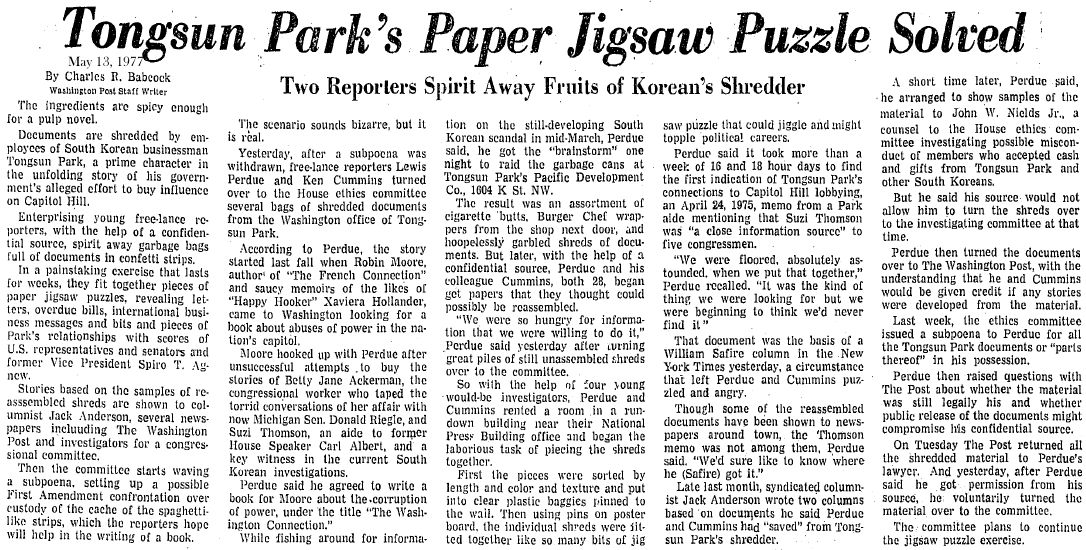
A 1977 book about the investigation of a
Congressional corruption scandal, entitled "
The Washington Connection," revealed the arduous and painstaking process journalists undertook to recompose shredded documents.
Reporter, and the book's co-author, Lewis Perdue later
recounted a story about his happening upon a photo of the Iranian de-shredding operation in the
Washington Post and seeing his own book in the background - open to the pages where he explains how to put shredded documents back together.
Perdue
states: "Nope, it wasn't a bunch of little carpet weavers as one story goes, or child labor as Argo played it." In fact, he adds, "the setting of their work looked a great deal like ours."
With this in mind, it seems that even when the CIA purports to tell the truth, it still winds up playing into propaganda.
*****