Friday, February 15, 2013

Announcement: Wide Asleep in America Meets Muftah

I am thrilled to announce that I have joined the online magazine Muftah as co-editor of its Iran, Iraq and Turkey pages.  Founded in 2010 by Maryam Jamshidi, Muftah is dedicated to providing "incisive analysis on the Middle East and North Africa (MENA) that eschew[s] Western obsessions with terrorism, oil, and Islamism and, instead, highlight[s] issues and concerns that mattered to the region’s people."

Furthermore, "Muftah is committed to fostering free and open debate about regional issues by featuring articles from diverse (sometimes conflicting) perspectives and working with a large and eclectic group of writers that include academics, practitioners, activists, and members of the MENA diasporas."

I am both honored and humbled to join Muftah's incredible team of writers and editors (not to mention its Board of Advisors), whose credentials, credibility and insight are matched only by their generosity, openness and dedication to truth and justice.

Please check Muftah frequently for impressive analysis and commentary on politics, art, culture and activism; add it to your bookmarks, Facebook, RSS feed, and Twitter.

Below is my first post for Muftah.

*****

In Iran, Sanctions Speak Louder Than Words

(Photo credit: Carrie Devorah, WENN.com)

Speaking at the Munich Security Conference in early February 2013, Vice President Joe Biden made headlines by reaffirming the Obama administration’s willingness to hold bilateral negotiations with the Islamic Republic of Iran over its nuclear program and other issues.

While holding fast to the Western narrative about Iran’s “illicit and destabilizing” nuclear project, Biden stated that the U.S. government “would be prepared to meet bilaterally with the Iranian leadership,” provided it “is serious” and the talks would be “real and tangible.”

Biden also noted, “there is still space for diplomacy, backed by pressure, to succeed.  The ball is in the government of Iran’s court.” These statements apparently refer to artificial deadlines placed upon such talks by Israeli Prime Minister Benjamin Netanyahu.

The initial response from Iranian Foreign Minister Ali Akbar Salehi, who was also attending the conference, appeared positive.  Salehi said that Iran was open to direct talks and that Biden’s remarks were “a step forward.” The foreign minister also noted that such an offer, when coupled with “the threatening rhetoric that everything is on the table” (read: a military attack on Iran to ostensibly prevent it from building nuclear weapons that the U.S. intelligence community continues to affirm it is not building and Iran consistently says it does not want), might not be completely genuine. Still, he said, there was “no red line for bilateral negotiations” if the American offer was indeed sincere.

Mainstream media in the West exploded just days later when Iranian Supreme Leader Ali Khamenei poured cold water on the prospect of bilateral talks.  “You are pointing the gun at Iran and say either negotiate or we will shoot,” Khamenei said of the United States. “But you should know that pressure and negotiations are not compatible and our nation will not be intimidated by these threats.”  This analogy of gunpoint diplomacy was later echoed by both Salehi and Iranian President Mahmoud Ahmadinejad.

“Talk is meaningful if it is based on goodwill, equal standing and when both sides do not want to apply tricks,” added Khamenei. “Talk as a tactic, a gesture of superpower, is only a deceptive move.”

Such goodwill is clearly in short supply between the United States and Iran.

Khamenei’s reaction to Biden’s conditional offer was widely viewed as evidence of Iranian obstinacy and unwillingness to engage substantively over the nature of its nuclear program – this, notwithstanding the fact that multilateral talks between Iran and the P5+1 (Russia, China, France, Britain, the United States, and Germany) will resume in Kazakhstan at the end of this month.

At least one crucial detail was routinely excluded from commentary related to Khamenei’s statements: the ongoing U.S.-led economic war against Iran. Just one day before Khamenei’s speech, U.S. Treasury Undersecretary David Cohen announced that the United States was “expand[ing] the scope of sanctionable transactions with the Central Bank of Iran and designated Iranian financial institutions by restricting Iran’s ability to use oil revenue held in foreign financial institutions as well as preventing repatriation of those funds to Iran.”

These actions were taken despite the fact that such measures are well known to produce shortages of medicine and medical supplies that severely impact Iran’s civilian population while leaving its government relatively unscathed.

Meanwhile, European Union courts have been striking down EU-imposed sanctions on Iranian banking institutions as illegitimate and illegal.  Nevertheless, just this week, the U.S. State Department levied still more sanctions on Iran.

While the United States clearly wishes civilian suffering will turn the Iranian population against its own leadership, a recent Gallup poll reaffirmed what many already knew: Iranians blame the United States, not their own government, for their hardship and deprivation.

“The new round of sanctions,” Foreign Ministry spokesman Ramin Mehmanparast declared, “are designed to put pressure on the nation and to create a gap between the (Iranian) nation and government” by attempting “to create tension, crisis and instability.”

Khamenei himself has frequently and consistently pointed out the futility of accepting an offer to negotiate when under threat, siege, sanction and sabotage.  In March 2009, he noted that such offers are duplicitous. “If you go on with the slogan of discussion and pressure, saying that you will negotiate with Iran, and at the same time impose pressure, threats, and changes, then our nation will not like such words,” Khamenei said.

The following year, in August 2010, he reiterated this position. “In spite of all these measures, the Americans shout the slogan of negotiations. They impose unilateral sanctions, issue resolutions and make military threats, but at the same time they propose negotiations,” he explained, adding that “negotiations that are conducted under threats and pressures are not in fact negotiations.”

This is not just an Iranian conclusion.  Robert Hunter, former U.S. ambassador to NATO, recently lamented that “in the last three administrations, we have been unwilling to put on the table a negotiating position that has a chance to succeed,” and added, “No country can negotiate seriously when it is under military threat, facing sanctions that only help to strengthen the regime domestically, and with no serious proposals on the ‘plus’ side. Ironically, those who most talk about going to war with Iran also tend to be those who most oppose the U.S.' dealing directly with Iran and putting a realistic set of proposals on the table.”

While some informed commentators continue to hold out hope for a détente, without clear American acknowledgement of Iran’s inalienable right to a domestic nuclear enrichment industry and the cessation of criminal collective punishment against the Iranian population, it remains difficult to imagine this happening any time soon.

*****

Originally posted at Muftah.org.

*****

Thursday, February 14, 2013

The BBC Spins the Truth on Iran's New Centrifuges

The BBC published an impressive piece of scaremongering disinformation on February 13. In an article entitled, “Iran upgrades uranium enrichment despite US warning,” the news outlet reports that new, upgraded uranium enrichment centrifuges are now being installed at Iran’s primary enrichment facility in Natanz.

The report states that Iran itself announced the upgrade to the IAEA back on January 23 and quotes the head of Iran’s Atomic Energy Organisation, Fereydoun Abbasi-Davani, as saying, “We have produced the machines as planned and we are carrying out the installation gradually... to complete the tests relevant to the new generation.”

The BBC ominously notes, “Monitors say the new machines could significantly reduce the time needed to make a nuclear bomb” and reveals that this routine and much-needed technological advancement of an consistently monitored and safeguarded nuclear program has been referred to by the U.S. government as an “escalation.”

Yet this assessment is not only deceivingly broad, it deliberately omits readily available information that would undercut such unnecessary alarmism.

First, as Reuters reported on February 13 – but the BBC curiously didn’t – AEO chief Abbasi-Davani affirmed that the newly installed centrifuges “were specifically for lower-grade enrichment of uranium to below 5 percent purity.” In other words, these upgraded and more efficient machines cannot, by design and configuration, produce weapons-grade nuclear material. Rather, the level to which they will enrich uranium is well below the nearly 20% enrichment level used for cancer treatment and far from the over 90% required for a nuclear warhead.

Iran is well within its rights to upgrade its infrastructure; in fact, it would be irresponsible and absurd for it not to.  As Russian Foreign Minister Sergei Lavrov noted on January 31, “We were told by the IAEA that [the Iranians] will install next generation centrifuges. However, [Iran] is doing everything in line with their commitments under the Safeguards Agreement.”

Further, as the Christian Science Monitor explained last month after the upgrade to the Natanz facility was first announced, most of the enrichment technology currently used by Iran “is from the 1970s, and Iran has had difficulty in getting the centrifuges to run properly, perhaps in part due to the sabotaging effects of the Stuxnet computer worm thought to have been introduced into the plant by the US and Israel.” That said, the new centrifuges - only one generation newer than those currently installed and spinning - are not state-of-the-art by any stretch. The technology they employ is still only from the 1980s, if that.

Second generation centrifuges manufactured domestically by Iran is also not startling news.  As far back as February 2008 - yes, five years ago - there were reports of Iran installing new, advanced centrifuges (known as IR-2) at Natanz. Similar reports followed in 2010 and 2011.

Another factor left out of the BBC report is that Iran has also been actively converting quantities of its 20% enriched uranium into fuel plates for use in the Tehran Research Reactor – another IAEA safeguarded site – thereby reducing its amount of stockpiled material and precludes the possibility of potentially further enriching such material to higher, weapons-grade levels in the future.

By claiming only that the new centrifuges Iran is installing at Natanz “could significantly reduce the time needed to make a nuclear bomb,” the BBC is feeding unfounded fears while deliberately downplaying facts. That Iran’s nuclear program is anything but nefarious and clandestine still appears to be an unfathomable and inadmissible conclusion in the Western media.

*****

UPDATE:

March 3, 2013 - A Reuters news alert early today states that, according to Fereydoun Abbasi-Davani, head of Iran's Atomic Energy Organisation, Iran will soon be "producing 3,000 new-generation centrifuges."

"The final production line of these centrifuges has reached an end and soon the early generations of these centrifuges with low efficiency will be set aside," Abbasi-Davani said, according to the Fars news agency.

Despite the alarmist commentary that such an announcement will surely "add to Western concerns about the Islamic state's disputed nuclear programme," the plain fact is that this is neither alarming nor illegal. Iran, as mentioned above, has been transparent about its plans to increase the efficiency of its nuclear infrastructure under the supervision of the IAEA.

Literally, the only bit of news in this report is that the announcement "appeared to be the first time a specific figure had been given," says Reuters.

Specific figure, ahhhh!

In an updated, lengthier article published three hours after its initial report, Reuters explains, "An IAEA note informing member states in January about Iran's plans implied Iran could install up to 3,000 or so of the new centrifuges," adding, "Iran has for years been trying to develop centrifuges more efficient than the erratic 1970s IR-1 model it now uses, but their introduction for full-scale production has been dogged by delays and technical hurdles, experts and diplomats say."

So, Iran is doing exactly what it said it was going to do, ahhhhhhhhh!

The silliness continues.

*****

Thursday, February 7, 2013

The Talented Mr. Takeyh:
Why Doesn't the Council on Foreign Relations Fellow Like Flynt & Hillary Mann Leverett?

Ray Takeyh

If there’s one thing mainstream “Iran experts” hate, it’s well-credentialed, experienced analysts who dare challenge Beltway orthodoxies, buck conventional wisdom and demythologize the banal, bromidic and Manichean foreign policy narrative of the United States government and its obedient media. Such perspectives are shunned by “serious” scholars who play by the rules they and their former bosses themselves wrote; those propounding such subversive ideas are likewise excoriated and banished, labeled apostates and attacked personally for failing to fall in line.

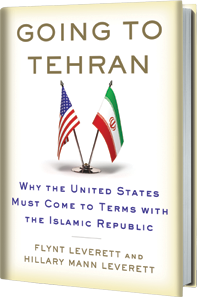
Enter Flynt and Hillary Mann Leverett, two former National Security Council officials, who have long questioned the wisdom and efficacy of the past thirty years of U.S. policy towards Iran. Their new expertly researched and meticulously-sourced book, Going to Tehran: Why the United States Must Come to Terms with the Islamic Republic of Iran, details and debunks numerous propagandized myths and delusional misunderstandings that many Americans have been led to believe about the country that is consistently referred to by our politicians and pundits as “the world’s most dangerous state.” The Leveretts argue that, by at least taking into account the Iranian side of things and reviewing the misguided, myopic and unsustainable American policies toward Iran, the groundwork may be laid for a constructive and beneficial change of course for both nations; by engaging openly and acknowledging past grievances – rather than ignoring, justifying or ridiculing them – a new future is possible, one without threats or war, without sabotage and cyberattacks, without demonization and demagoguery.

The problem is, without such things, the revolving door of Beltway think-tankery and government appointments might not spin so lucratively for our “Iran expert” industry. As a result, the Leveretts and their ideas are pilloried by political and policy elites who confuse heterodoxy for apologia.

In a supremely smug and self-satisfied pseudo-review of Going to Tehran, just published in Survival, the journal of the International Institute of Strategic Studies, Washington's "go-to" Iran analyst Ray Takeyh launches what is surely a paradigmatic opening salvo on the Leveretts’ work. Needless to say, he didn’t like the book; his review is the intellectual equivalent of a drive-by shooting. While lambasting the Leveretts, Takeyh fails to actually address any of their contentions or claims, preferring to make grandiose statements condemning their analyses of Iranian politics and foreign policy and their policy recommendations without bothering to back up these statements with evidence or explanation.

Takeyh is a mainstay of the Washington establishment – a Council on Foreign Relations Senior Fellow before and after a stint in the Obama State Department and a founding member of the neoconservative-created Iran Strategy Task Force who has become a tireless advocate for the collective punishment of the Iranian population in a futile attempt to inspire homegrown regime change (if not, at times, all-out war against a third Middle Eastern nation in just over a decade). Unsurprisingly, he dismisses out of hand the notion that "the principal cause of disorder in the Middle East today is a hegemonic America seeking to impose its imperial template on the region."

This is exactly the worldview that has produced the disastrous U.S. foreign policy of the last few decades, policies advocated time and time again by the same people – not only people like Takeyh, but including literally Takeyh himself – never learning from their mistakes or conceiving there might be a different way to engage the world (say, by not bullying, threatening, demanding, dictating, punishing, bombing, invading, destroying, dismantling, overthrowing, occupying, and propping up dictators). Takeyh’s contemptuous rejection of history means that those who disagree with him – like the Leveretts, even though their experience in government and direct contact with on-the-ground reality in today’s Iran dwarfs Takeyh’s – must inevitably be minions of the ayatollahs.

Takeyh's dismissal of the Leveretts’ work is especially ironic, given that his own analytic nonsense is legion. He routinely makes statements that aren't based in fact and that dispute even the most hysterical estimates of the United States government. He has no problem co-writing tomes of warmongering lunacy with psychotics like Matthew Kroenig, convicted criminals and racist demagogues like Elliott Abrams, and garbled inanity with his wife's insane colleague at the Saban Center and perennial war champion Kenneth Pollack. Everything he writes is easily destroyed with a basic perusal of facts.

Never bothering to cite any evidence, Takeyh has long assumed Iran - oh sorry, I mean, "the mullahs" (how spooky!) - are building a nuclear bomb and only the fierce determination of the United States, its benevolent buddy Israel and vital Arab dictator friends can stop it, if not by beating the Islamic Republic into submission through economic and covert warfare, then perhaps by military might. In April 2003, he wrote, “Tehran often claims that instability in the region forces it to pursue nuclear weapons, when in fact it is Iran’s possession of such weapons that would increase instability.” Actually, Iranian officials have never claimed anything remotely like that, instead declaring their commitment never to build nuclear weapons consistently for over 20 years. In 2011, Takeyh assured Washington Post readers, "Exact estimates vary, but in the next few years Iran will be in [a] position to detonate a nuclear device."

In October 2011, when the US government tried to pretend that a bumbling, bipolar Iranian used-car salesman in Texas had been tasked by the Iranian Revolutionary Guard Corps to hire a Mexican drug cartel to assassinate the Saudi ambassador in a DC restaurant (it is literally impossible to read that without chuckling), Takeyh took to the airwaves to comment on the alleged plot. Speaking on NPR, Takeyh wholly endorsed the U.S. government's version of events, never for a second doubting their authenticity. Though he claimed it was “unusual," Takeyh made sure to add, "I don't know what the evidence about this is, but I'm not in a position to doubt it."

There you have it, folks, Takeyh's entire method of scholarship in a nutshell.

Takeyh’s disdain for empirical reality allows him to take multiple, often contradictory positions on many issues—whatever it takes to align himself with “centrist” foreign policy hawks in the Democratic Party’s national security establishment. In 2006, after the occupation of Iraq had turned irrevocably catastrophic and Democrats were looking for ways to distance themselves from Bush’s Middle East follies, Takeyh argued “for the United States to become more directly engaged in negotiations with Iranians and also make an offer of some corresponding concessions.” While assuming an Iranian desire for latent nuclear weapons capability, he held, “I don't think they've made up their mind yet to cross the threshold and actually weaponize [nuclear power].” He added, “For those who suggest that it is absolutely conclusively determined that Iran wants to have nuclear weapons, I think it behooves them to provide some kind of evidence for that claim.” Just months later, though, Takeyh told the Senate that Iranian leaders were determined to achieve hegemony in the Persian Gulf and that, from their vantage, "it is only through the attainment of the bomb that Iran can negate the nefarious American plots to undermine its stature and power.

As the possibility of Democratic victory in the 2008 presidential election drew closer, Takeyh’s views grew more hawkish. His transformation into an Iran hawk accelerated with his brief stint in the State Department during the Obama administration’s first year. In 2010, he co-wrote a journal essay and accompanying op-ed that sought to characterize war with Iran as a natural outcome, a normalized and inevitable progression of history. Over the next couple of years, he fully realized his penchant for conflating Iran’s monitored and safeguarded nuclear energy program with a nefarious, clandestine weapons program.

This conflation is present in Takeyh’s attempted takedown of Going to Tehran, where he references Iran’s “nuclear infractions,” but provides no evidence for them other than collective Beltway wisdom, displaying a complete ignorance of what IAEA reports actually say and where such accusations actually come from (unverified American and Israeli allegations). His determination to blame only Iranian “intransigence” for the current nuclear dispute epitomizes the intellectual dishonesty for which most Washington think-tanks are unfortunately revered.

Takeyh's analytic malfeasance extends to Iran’s domestic politics as well. His conversion from unimpressive establishment scholar to full-blown neocon fellow traveler is underscored by his remarkable insistence that Iran's clerics are to blame for the 1953 CIA coup that overthrew Prime Minister Mohammad Mossadegh (sic). Takeyh also refuses to understand the reality of the Green Movement in Iran, elevating them to surreal heights of organization, unity and potential.

In his review of Going to Tehran, Takeyh notes what he calls “transparent electoral fraud in the presidential election” of 2009, but again fails to advance any actual documentation to support this contention. Since 2010, he has been warning us all of Ahmadinejad’s impending consolidation of power over the Iranian government. This didn’t happen. Good call, Ray, how astute.

The self-serving vacuity of Takeyh’s review is especially glaring in his treatment of the Leveretts’ critique of U.S. policy toward Iran. As the Leveretts themselves have already noted, Takeyh is adamant that the U.S. has often and openly reached out diplomatically to Tehran but can't seem to square this with reality – including statements made by his former boss, Dennis Ross, who sees the perception of failed diplomacy as necessary to sell the American public on a new illegal war against another enemy that poses absolutely no threat to the United States.

Takeyh complements his rewriting of diplomatic history with a selective – indeed exploitative – focus on human rights issues in Iran. Along with the vast majority of the Leveretts’ detractors (and anyone else who rejects a reality-based approach to the three-decades-long U.S.-Iranian impasse), Takeyh seems unaware that basing American foreign policy on human rights is not only disingenuous, but also contrary to how the U.S. actually operates all over the world.

Going to Tehran is a policy prescription addressed primarily to the government of the United States, not to human rights organizations. Iran has as abhorrent a human rights record as many other countries - far worse than many, better than others. But the United States government has never cared one iota about human rights when it comes to strategic partnership with its closest and most trusted political allies (let alone its own actions).

Whether looking at our torture regime, our indefinite detention, our illegal drone program, our invasions, our assassinations, our surveillance state, our contempt for due process, our racist justice system and bloated prisons, and - perhaps, most relevant - our continued support and encouragement of ongoing Israeli war crimes, ethnic cleansing, colonization and occupation of Palestine alongside weapons sales and willful blindness to the atrocities of true dictatorships like Saudi Arabia and Bahrain, the concept that American diplomacy or interests rest upon virtuousness and humane practices is not only hypocritical; it's downright laughable. As Glenn Greenwald recently wrote about Iran, Syria and Libya, “That the US and its Nato allies - eager benefactors of the world’s worst tyrants - are opposed to those regimes out of concern for democracy and human rights is a pretense, a conceit, so glaring and obvious that it really defies belief that people are willing to advocate it in public with a straight face.”

If our government cared about human rights it wouldn't be subjecting the Iranian people (who wholeheartedly oppose American sanctions and constant bullying) to collective punishment, just like it did the people of Iraq - the half million Iraqi children sacrificed to similar sanctions know full well the American consideration for human rights. Takeyh reflects this duplicity in his review, noting the appalling history of “show trials, mass repression and persistent international transgressions” in Iran and condemning the Leveretts for not making this the focus of their book. Yet if Takeyh actually cared about fundamental human rights and the importance of international law, he would not only call for Congress to sanction Israel and Saudi Arabia, he would be outraged by the closeness of these governments to his own here in the United States. But he doesn't. Only Iran is the target of his anger and concern.

Because for the U.S. government, human rights abuses are used merely as a bludgeon against its adversaries while the myriad transgressions of its strategic partners are routinely ignored (if not, in the case of Israel, even funded and justified), Takeyh’s argument is disingenuous at minimum. As always, he and his fellow mavens of the established foreign policy community are silent about America’s role as the guarantor of Middle Eastern tyranny, as long as its puppet dictators do our bidding, namely with regard to acquiescing to Israeli regional hegemony and following the U.S. lead on isolating and threatening Iran.

In the most recent Human Rights Watch report, we learn that a large Middle Eastern country, ruled by an unelected religious fundamentalist misogynistic elite, has "arrested hundreds of peaceful protesters during 2012, and sentenced activists from across the country to prison for expressing critical political and religious views." Not only this, but "thousands of people are in arbitrary detention, and human rights activists were put on trial on politicized charges. The Ministry of Interior forbids public protests. Since 2011, security forces have killed at least 14 protesters in the Eastern province who were seeking political reforms."

It finds that the "government has gone to considerable lengths to punish, intimidate, and harass those who express opinions that deviate from the official line," while "lawyers are not generally allowed to assist suspects during interrogation, and face obstacles to examining witnesses or presenting evidence at trial." Furthermore, "Authorities have used specialized criminal courts, set up to try terrorism cases, to prosecute a growing number of peaceful dissidents on politicized charges."

What country is this? Saudi Arabia, the leading U.S. trading partner in the Middle East, which receiving billions upon billions of high-tech weaponry from our noble nation year after year. The United States uses a secret Saudi base as a launchpad for lethal drone strikes in neighboring Yemen and is even working closely with the Kingdom on its nascent nuclear program. One wonders if this recent case (one of the worst things I have ever heard about) will cause the U.S. to reconsider its relationship with Saudi Arabia. Don't hold your breath. But just imagine if that had happened in Iran.

Our best friend in the world, Israel, meanwhile is a militarized colonial state in routine contravention of existing international and humanitarian law. Ample evidence reveals the illegality of Israel's Apartheid Annexation Wall, Israel's use of administrative detention to hold Palestinians indefinitely without charge or trial and the rampant Israeli arrest of Palestinian children and toddlers, who suffer abuse - mental, physical and sexual - and who are tortured during and traumatized by their imprisonment. Palestinian communities are constantly victimized by housing demolitions and eviction, a particularly vindictive form of collective punishment favored by the Israeli government.

None of this seems to bother our government one bit and any attempt to hold Israel accountable for its crimes is met with derision in the circles in which Mr. Takeyh travels, all expenses paid, of course.

The issue isn't about whitewashing or justifying abuse and repression; it's about U.S. government policy, which clearly has no problem overlooking such horrors depending on who commits them. If the U.S. were consistent in its concern for human rights (rather than selectively using them only to condemn its enemies), Takeyh might have a point. But it isn’t, so he doesn't.

The Leveretts explicitly address this issue in Going to Tehran. They write, “Washington has never demonstrated that it cares about human rights in the Middle East for their own sake. It cares about them when and where caring appears to serve other policy goals.” In their explicitly stated effort “to outline a potentially far more efficacious diplomatic approach” (p.388), the Leveretts point out that “the only way human rights conditions in the Islamic Republic, as defined by Western liberals, are likely to improve is in a context of U.S.-Iranian rapprochement, whereby the United States had credibly given up regime change as a policy goal.” (p.326)

While conventional Washington wisdom (and actual acts of Congress and executive orders by the President) hold that the U.S. government should be critical of Iran’s human rights record as a matter of policy, doing so is pure propaganda. The United States is in no position to affect the violations of the Iranian government because it has no diplomatic presence, credibility or connection to the Islamic Republic. As George W. Bush admitted in December 2004, in a rare moment of candor and honesty, “We’re relying upon others, because we’ve sanctioned ourselves out of influence with Iran…We don’t have much leverage with the Iranians right now.”

Takeyh, by employing ad hominem attacks on the Leveretts in an effort to label them apologists for theocratic authoritarianism and thereby discredit their views, is trying to poison the well, so to speak, with anti-war progressives who might find a new approach to Iran novel and welcome. He calls Going to Tehran “tedious,” “stale,” and “trite.” That’s coming from a guy who works at the Council on Foreign Relations and writes about implementing even more “crippling” sanctions on Iranians in order to compel their government’s capitulation to American and Israeli diktat. How original, fresh, and innovative!

Regardless of whether one finds their arguments compelling or their history sufficiently comprehensive, the Leveretts deliver a blow to the establishment narrative of “what to do about Iran.” It is no surprise that Ray Takeyh is offended by the Leveretts – they directly address the danger he and others like him in the official foreign policy community pose to those who oppose another war.

They write that the claims put forward by Takeyh “that Iran’s leadership is too ideologically constrained, fractious, or politically dependent on anti-Americanism to pursue a strategic opening to the United States are not just at odds with the historical record. Such claims push the United States ever further in its support of coercive regime change and, ultimately, down the disastrous path toward war.” (p.108)

The main thesis of Going to Tehran, as evident in the book’s title, holds that, as American power declines worldwide, recognition of faulty and detrimental foreign policy is required for the U.S. to better adapt to an ever-changing and more independent Middle East; a region in which Iranian influence is ascendant whether we like it or not. They see the precedent set by Richard Nixon’s historic visit to China as the best way forward with regard to Iran.

Such a suggestion, while increasingly relevant, is not actually new. A noted foreign policy expert proffered an identical view in 2006, explaining, “First of all, this is not a unique historical moment for the United States. We've been in this position before. If you look back in the late 1960s, early '70s, we were in a position in East Asia where our power was declining because of the Vietnam War, and the Chinese power was increasing because of China's own capability and declining American power. And then there was certainly antagonism between the two countries.

Lamenting the “conceptual divergence” of Iranian and American negotiating positions, the analyst continued,
"I think you have to accept certain basic realities. Iran is an important power with influence in the region, and the purpose of the negotiation would be how to establish a framework for regulation of its influence. Therefore, in a perverse sense, negotiations [are] a form of containment. We're negotiating as a means of containing Iran's influence, surely as we negotiated with the Chinese in the early 1970s as means of coming to some arrangements to rationalize U.S.-Sino American relations as a means of regulating Chinese power."
He further insisted that the United States must take a bold step to enter into “comprehensive negotiations on all of Iranian concerns and all of our concerns. Our concerns are human rights, terrorism; they have their own grievances and so forth. And these negotiations will take place ultimately without precondition,” just as negotiations with China in 1970 were not preconditioned.

Again making the explicit analogy to Nixon’s overture to Beijing, he stated, “The purpose of these negotiations would be to foster an arrangement where Tehran's relationship with Washington is more meaningful to it than various gradation of uranium or potentially its ties with Hezbollah.” This way, he concluded, an “end point” would be reached “by creating a new framework and a new basis for U.S.- Iran relations,” which would, in order to be at all successful, have to recognize Iran’s position in its own neighborhood. “[I]n all these discussions and negotiations,” he affirmed, “we have to appreciate that in a sense we are legitimizing Iran's at least Persian Gulf if not larger regional aspirations."

That analyst was Ray Takeyh. He was addressing the Senate Foreign Relations Committee of the 109th Congress. Sitting on the Committee at the time of his statement were John Kerry and Chuck Hagel. Its ranking member was Joe Biden. Also on the committee? The junior Senator from Illinois, Barack Obama.

Just six months later, Takeyh wrote in Foreign Affairs that no U.S. policy regarding Iran in the past thirty years has worked. Noting the impossibility of regime change, military action, isolation and obstinacy, Takeyh wrote the U.S. government must abandon these “incoherent policies” and “must rethink its strategy from the ground up.”

He continued,
“The Islamic Republic is not going away anytime soon, and its growing regional influence cannot be limited. Washington must eschew superficially appealing military options, the prospect of conditional talks, and its policy of containing Iran in favor of a new policy of détente. In particular, it should offer pragmatists in Tehran a chance to resume diplomatic and economic relations.”
He added, “The sooner Washington recognizes these truths and finally normalizes relations with its most enduring Middle Eastern foe, the better.”

This is literally what Going to Tehran is about. Literally.

By attacking the Leveretts’ new book, Takeyh is attacking the very ideas he himself has espoused so confidently, both in a leading policy journal and to a senate Committee that included the current administration’s President, Vice President, Secretary of State and Secretary of Defense themselves.

But he doesn’t want you to know that.

***** ***** *****

Originally posted at Antiwar.com

*****

UPDATE:

February 15, 2013 - In a new opinion piece for the Los Angeles Times, Ray Takeyh stops warmongering for a second and takes a deep breath.  While he still assumes that Iran is actively attempting to acquire nuclear weapons capability (incidentally, this is inevitable regardless of intent considering the technological and technical specifics of a fully functioning nuclear energy program and enrichment facilities), Takeyh now suggests the United States abandon its stubborn all-or-nothing approach to negotiating with Iran.

He notes that Iran's "multilayered, multifaceted program can be dealt with only on a piecemeal basis, as the technical details and rules for inspections are too complex to be addressed in a single agreement," and adds that, even if offered a proposal, "Tehran still has a right to contest and negotiate its provisions and offer counterproposals," especially since "[t]he international community is unlikely to concede to either more sanctions or the use of force until Iran's objections are taken into full consideration."

Takeyh's softer side is on full display throughout the article, even when he writes of the "diplomatic challenge...to derail this path to a nuclear weapon."  He posits this be achieved "through a process that proceeds incrementally and sequentially."  He rightly continues:
U.S. officials would be wise to get out of the crisis mode and put some time back on the clock. The Iran issue always seems urgent, and yet somehow there is always time to deal with it. Washington should acknowledge the obvious, namely, that given Iran's gradualist approach, it is still years from completing an efficient enrichment infrastructure, constructing a nuclear arsenal and developing a reliable means of delivery. By agreeing to a compressed timeline, the U.S. only narrows its options and makes a solution even more elusive.
This is welcome advice from the Senior CFR Fellow.  Hopefully those who pay attention to his analysis will heed this particular advice before he publishes something else in the future that totally contradicts these current conclusions.

*****

Wednesday, February 6, 2013

Iraq, Iran, Red Lines and Headlines


Could this repeated history be any more obvious?

This was April 12, 1995:


This was March 4, 2002:


And this was November 8, 2011:


This was August 5, 2002:


And this was November 8, 2011:


This was September 9, 2002:


And this was October 9, 2012:


This was also September 9, 2002:


And this was July 15, 2009:


This was September 17, 2002:


And this was June 1, 2012:


And this was May 9, 2006:


This was September 22, 2002:


And this was November 6, 2011:


This was September 10, 2002:


And this was November 9, 2011:


This was February 6, 2003:


And this was May 17, 2012:


This was March 8, 2003:


And this was October 28, 2007:


This was February 6, 2004:


And this was March 23, 2012:


This was April 19, 2004:


And this was January 10, 2012:


This was September 17, 2004:


And this was January 27, 2009:


This was October 6, 2004:


And this was October 22, 2007:


Yet this was November 4, 2007:


And this was January 25, 2010:


This was April 25, 2005:


And this was October 8, 2012:


This was September 6, 2007:


And this was February 24, 2012:


And this was August 9, 2012:


And this was September 17, 2012:


Then this was October 30, 2012:


Still this was January 14, 2013:


Now this was February 4, 2013:


*****

UPDATE:


*****

Thursday, January 31, 2013

The Ongoing Saga of Bad Websourcing:
Does Al-Monitor Even Have Editors?

It is becoming increasingly obvious that prolific Israeli commentator Meir Javedanfar is unaware of the purpose of hyperlinks.

In his January 30 Al-Monitor article (which incidentally needs some major copy editing, but didn't get it), Javedanfar writes, "Iran is also using Syria as a proxy to weaken the Syrian opposition forces, which it sees as the allies of the West, Saudi Arabia and even Israel."

The link on "Israel" leads to a PressTV article wherein no Iranian makes any such claim. It just quotes the Israeli President Shimon Peres as supporting the Syrian opposition. No loony Persian conspiracy theories or official statements by Iranian political or military leaders. So why does Javedanfar use this particular link when the claim he makes is about what Iran "sees as..."? For the answer, go here.

Furthermore, that the US, European countries and Arab Gulf states are not only "allies of" but literally funding, equipping and arming the Syrian opposition is common knowledge that doesn't need to be pawned off as some crazy Iranian allegation. It's also easily accessible information. See all those links? Yeah, it's that easy.

One additional point: Javedanfar's use of the term "proxy" to describe Iran's relationship with Syria is bizarre and demonstrates either a lack of understanding about what that word means or about how civil wars work. A "proxy" is a subordinate agent or organization that takes its cues from and whose interests are beholden to a more powerful, external benefactor. It doesn't make much sense to refer to a sovereign government (especially one that is itself embroiled in a bloody civil war), rather than a non-governmental organization or group, as a proxy of another sovereign government.

Yes, there are exceptions to this - for example, nations like Palau, the Marshall Islands, and Micronesia are often used as U.S. proxies during United Nations General Assembly votes against Israeli accountability and the implementation of international law in Palestine. But those nations don't have interests of their own in that particular region; also, they are party to the Compact of Free Association with the United States, which mandates American military protection, financial assistance and economic provisions for these tiny Pacific Island states in return for diplomatic fealty (the nations vote alongside the U.S. and Israel in the U.N. more than 90% of the time, for example) and, more importantly, essentially wide-open U.S. military access.

As per the agreement, established in 1986 (and 1994 for Palau as an independent entity), these protectorates - which were previously under American trusteeship since the end of World War II - must grant the U.S. military exclusive access to their territories and provide land for military bases, not to mention accommodating the constant presence of U.S. military recruiters who have long preyed upon the poor local communities with promises of economic opportunity. In 2010, the Christian Science Monitor reported that "while some Micronesians see the US military as their ticket out, many here are poorly informed of the risks. The FSM has suffered more casualties in Iraq and Afghanistan per capita than any US state, and has lost soldiers at a rate five times the US average. Some recruits sign on unaware the US is fighting two wars."

But I digress.

Javedanfar calls the Assad-led Syrian government a proxy of Iran, which Iran is using against Syrian opposition forces which means that the Syrian government is doing Iran's bidding by fighting against armed rebel militias in its own country than are trying to overthrow it. Huh? The Syrian government may be getting support - both financial and military - from Iran, but that doesn't make it a lackey of Iran, which is what the term proxy signifies. It is obviously in Assad's own interest to oppose forces seeking to topple his dictatorial reign; he doesn't need Iran's say-so to do what he's doing.

Yet, by Javedanfar's reading, the conflict is really between Iran and Syrian opposition forces. The Syrian government, according to him, is merely a pawn in Iran's game against Israel and the West. This both obfuscates and confuses the issue. (The term proxy itself is overused when discussing allegiances and alliances in the region; both Hezbollah and Hamas are routinely referred to as Iranian proxies yet the fact is that they don't have their interests or actions dictated to them by the Iranian government as they are indigenous groups with their own goals and responsibilities.)

Sure, it's obvious what Javedanfar is trying to say - in the assumed power struggle over influence in the Middle East, Iran and the West/Gulf alliance are each protecting their own interests in Syria (duh) - but that's not really what he wrote. The problem here may be poor writing skills, but isn't that where an editor should step in and clarify?

One last thing: Javedanfar suggests that to prevent the alleged Syrian stockpile of chemical weapons from "falling into the hands of al-Qaeda" were "an extremist offshoot" of the group to seize power after Assad's supposed fall, those weapons should be transferred to...wait for it...Iran.

Why, you may ask? Because Javedanfar states that, Iran having chemical weapons is "infinitely better" than al-Qaeda having them, provided that is "the only other viable option." Sure, ok. But he never explains why that would be the only option or points out that the backers of criminal al-Qaeda-affiliated elements in the Syrian opposition are the very states he says are duking it out with Iran in a proxy war.  How could Iran getting chemical weapons be part of the end-game in Syria as far as the West, Israel and Saudi Arabia are concerned?

It can't and won't be. Which makes Javedanfar's commentary not only pointless, but just plain weird.

What he's really saying, though, is that he wants Syria's alleged chemical weapons stockpile to get as far away from him, his family and his friends who are living in Israel as possible. This is understandable, of course, but does it really necessitate a prominently displayed opinion piece on Al-Monitor that no editor took a look at before it was published?

*****

UPDATE:

February 1, 2013 - Javedanfar has a truth problem. The article he published a week ago, also in Al-Monitor, is rife with errors. In response, USC professor Muhammad Sahimi and I wrote the following (which Al-Monitor - after a week of nit-picking back-and-forth - refused to publish).

Talking about Iran’s Nuclear Program: Facts versus Fiction

In his latest column published by Al Monitor, Israeli commentator Meir Javedanfar discusses the stagnancy of Israel’ policy toward Iran and concludes that "[t]he results of the recent Israeli elections are unlikely to bring much change to Israel’s current Iran strategy," which, according to him, consists mainly of Israeli Prime Minister Benjamin Netanyahu "repeating 'Iran,' 'Iran,' 'Iran' as loudly as possible" and "continuing to threaten Iran with the military option."

Mr. Javedanfar's most sweeping statement, however, is that "the Iranian regime's behavior" is "first and foremost" to blame for this obsessive Israeli hysteria and relentless threats. He writes,
As long as Iran refuses to answer the International Atomic Energy Agency (IAEA)'s questions about suspected weapon-building activity (including alleged activities related to building a nuclear trigger), nobody in Israel will believe the narrative that Iran only wants energy for peaceful purposes. On top of that, Iran hid Fordo from the IAEA before opening it, which former IAEA head Mohamed ElBaradei said was "on the wrong side of the law."
Mr. Javedanfar’s uncritical repetition of these allegations is unfortunate. Such a characterization of Iran’s nuclear program reinforces the false narrative and misinformation that are so often manipulated to justify increasingly hawkish policies toward Iran and contradict what objective analysts of the Iranian program believe.

First, the "suspected weapon-building activity" that Mr. Javedanfar refers to simply doesn't exist. The National Intelligence Estimate of 2007, reaffirmed ever since (in 2009, 2010, and again in 2011), stated that [if] Iran did have a nuclear weapon program, it stopped it in 2003. Moreover, the United States intelligence community and its allies, including Israel, have long assessed that Iran is not and never has been in possession of nuclear weapons, is not building nuclear weapons, and its leadership has not even made the political decision to do so.

In early 2012, James Clapper, Director of National Intelligence, stated in testimony before the Senate Armed Services Committee, “We do not know…if Iran will eventually decide to build nuclear weapons." The same day, Defense Intelligence Agency Director Ronald Burgess said that “the agency assesses Iran is unlikely to initiate or intentionally provoke a conflict” and maintained that Iran’s military doctrine is defensive in nature and designed only for deterrence.

Even if Iran were to technically acquire the capability to make nuclear bombs and stopped short of militarizing its program, far from being a rogue outlier, it would be joining a nuclear club of dozens of other nations that currently have the materials and knowledge to rapidly produce nuclear weapons.

The IAEA itself continually confirms that Iran has no active nuclear weapons program and has stated it has "no concrete proof that Iran has or has ever had a nuclear weapons program." (emphasis ours). IAEA inspectors have never found evidence of illegal nuclear activity in Iran, even after Iran voluntarily accepted the intrusive inspections of the IAEA’s Additional Protocol for over two years. As far back as 1992, chief inspector Jon Jennekins declared that "everything that we have seen is for the peaceful application of nuclear energy and ionizing radiation." The Agency consistently reports it has found no evidence of diversion of nuclear materials from peaceful to non-peaceful purposes or any evidence of a secret parallel program for making nuclear weapons in Iran.

Nobel laureate and former IAEA Director-General Mohamed ElBaradei also reveals in his memoir that “the supposed evidence that had led [the U.S.] to confirm the existence of a past Iranian nuclear program” was just “the same unverified set of allegations about weaponization studies that had already been discussed with the Agency” and lamented the America’s “eagerness to promote unverified intelligence as evidence.” In 2007, an unnamed senior official at the IAEA revealed, “Since 2002, pretty much all the intelligence that's come to us [from the United States] has proved to be wrong.”

Furthermore, allegations about nuclear trigger research, which Mr. Javedanfar mentions specifically, are derived from dubious documents and have been eviscerated by investigative journalist Gareth Porter for some time now. Not surprisingly, these claims come from the same font of forgeries that have been widely acknowledged to have been passed on to both the IAEA and the media by Israeli intelligence officials.

Still, Iran is not being accused of currently researching or developing nuclear weapons technology, but rather of conventional high explosives testing that occurred roughly a decade ago, if not earlier, in Parchin, a non-nuclear military complex southeast of Tehran. Upon twice visiting the suspected site in 2005, an IAEA official recalled, “there was no sign of [banned nuclear] activities.”

The continued focus on Parchin, which is outside the legal purview of the IAEA, has led former IAEA head Hans Blix to note, “Any country, I think, would be rather reluctant to let international inspectors to go anywhere in a military site,” adding, “the Iranians have been more open than most other countries would be.”
Mr. Javedanfar's point that "Iran hid Fordo from the IAEA before opening it" is also mistaken. The existence of the Fordo site was announced by Iran to the IAEA on September 21, 2009, far in advance of the 180 days before becoming operational as required by Iran's Safeguards Agreement. At the time, the facility was still under construction and did not actually begin uranium enrichment until early January 2012, 840 days after it had been declared to the IAEA. ElBaradei even described the facility as “nothing to be worried about.” Regardless, like all other nuclear facilities in Iran, the IAEA has confirmed that “all nuclear material in the [Fordo] facility remains under the Agency's containment and surveillance." To date, this remains to be true.

None of the current allegations regarding Iran’s nuclear program has been a result of the IAEA’s own inspection of Iran’s nuclear sites; rather all accusations are based upon “evidence” supplied to it by a third party, particularly Israel. In contrast to an objective assessment of the facts, Mr. Javedanfar’s contentions promote a highly sensationalized description of Iran's nuclear program, one that corresponds more closely to the deliberately deceiving talking points of the American and Israeli governments than to the informed analysis of qualified experts. As a prolific commentator on this issue, Mr. Javedanfar should be much more careful about how he characterizes the Iranian nuclear program and far more diligent in providing documentation to support his claims.
_____

Muhammad Sahimi, a Professor at the University of Southern California, is co-founder and editor of the website, Iran News & Middle East Reports, and has published extensively on Iran’s nuclear program.

Nima Shirazi is an independent researcher and political commentator from New York City, where he runs the blog, Wide Asleep in America. Follow him on Twitter @WideAsleepNima
*****